
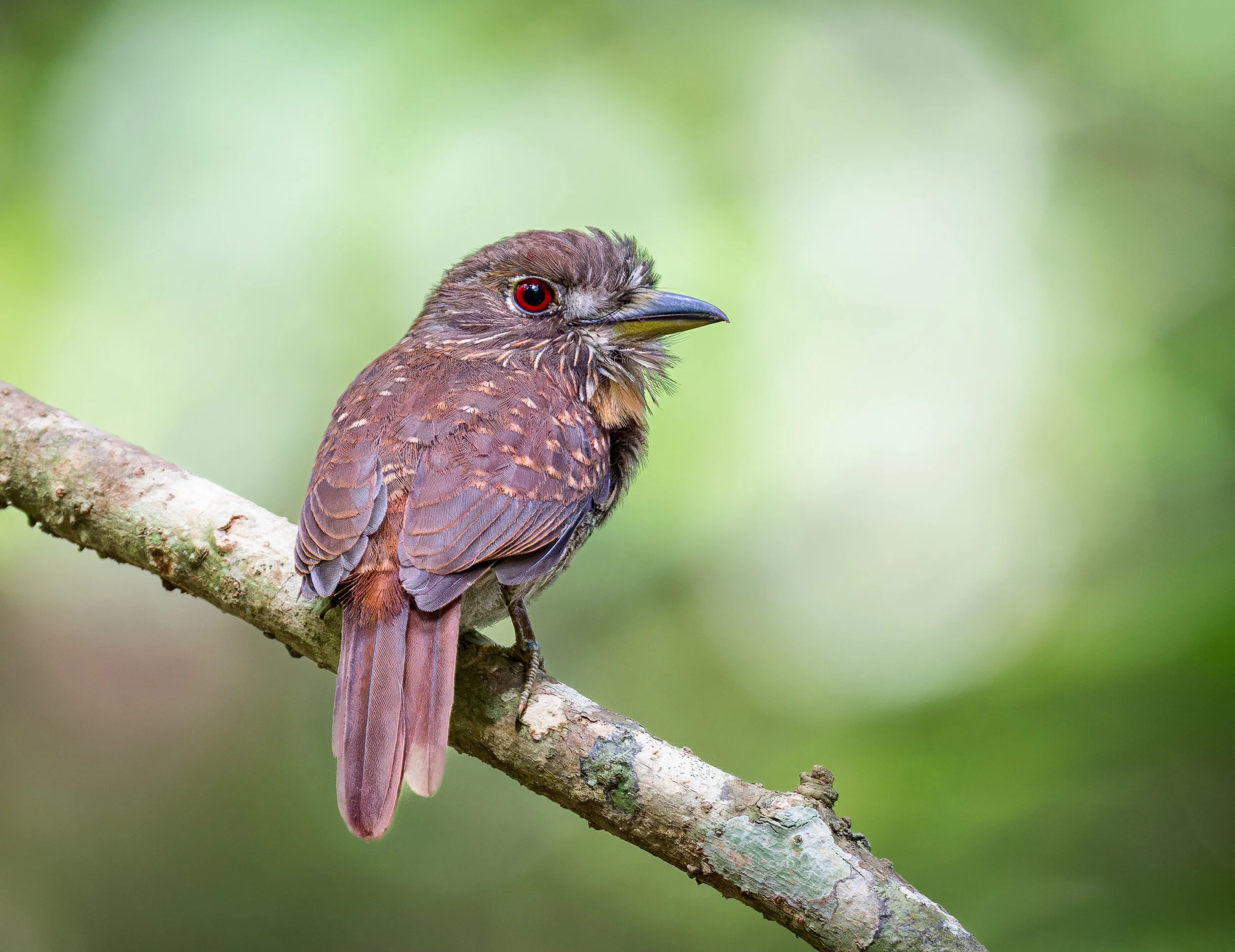
Feathers do not hang statically on birds like clothing. Birds have remarkable muscular control of them, and the basic design of their wing bones mirrors our own arms. Their primary flight feathers are attached to their fingers and can be manipulated with great precision, just as we have fine motor control in our hands. Body feathers move in groups, and can be held tight to the body, “sleeked,” or fluffed up. Puffbirds tend to hold their body feathers loosely at rest, giving them a puffy appearance, thus the very literal name. It’s the same mechanism by which a dog raises its “hackles” or a porcupine stiffens its quills—tiny muscles called piloerectors that work equally well with feathers or fur. You have them too, but we humans have lost voluntary control of them, along with most of our hair. So, instead of fluffing our feathers or raising our hackles, we get goosebumps. When nature finds a design that works, she repurposes it across seemingly unbridgeable divides, connecting all living things through shared patterns of form and function.
WHITE-WHISKERED PUFFBIRD (Malacoptila panamensis)