
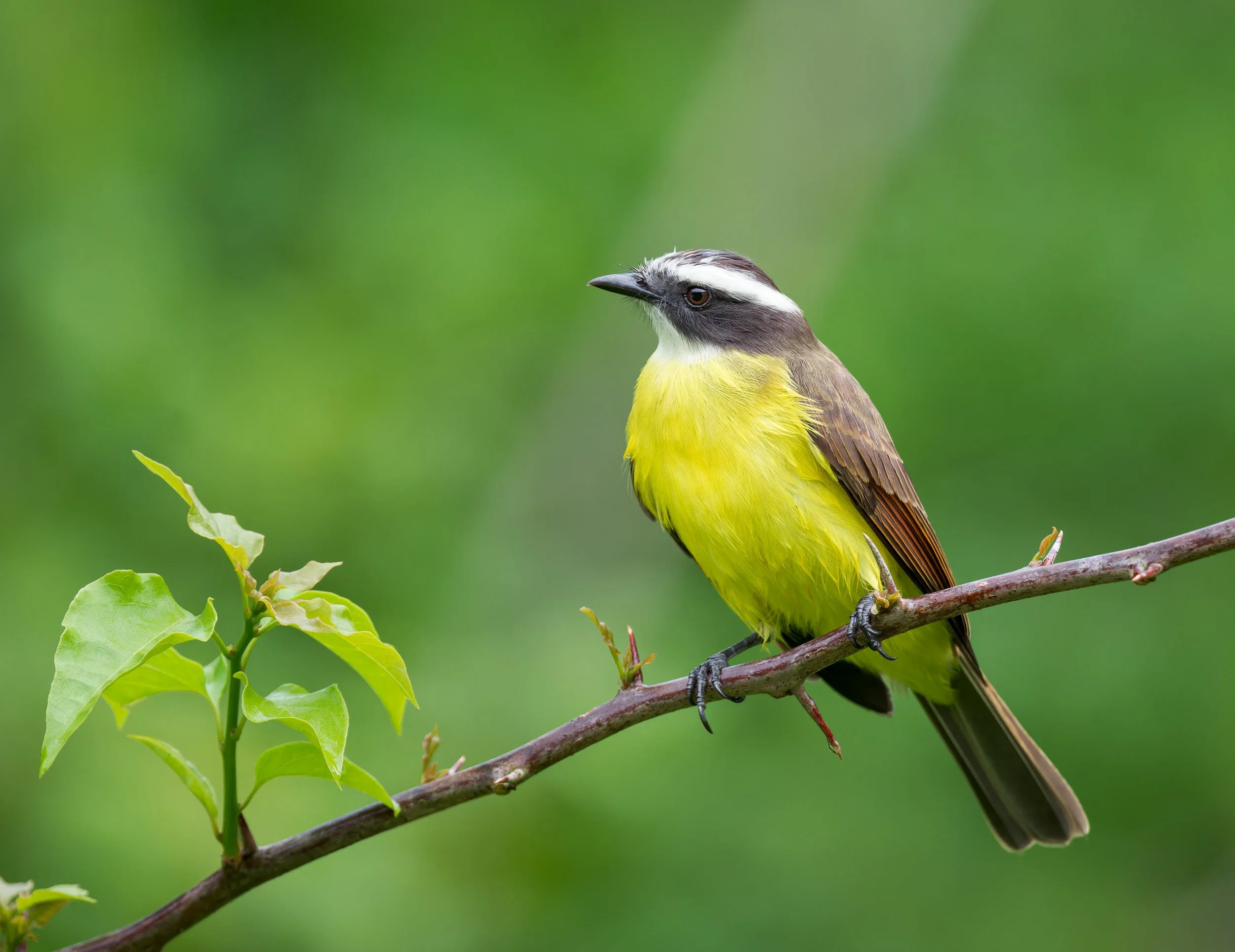
Flycatchers, the family Tyrannidae, eat most anything resembling an insect, not just flies. It is apparently a good way for a bird to make a living, because with well over four hundred species, Tyrannidae is a long limb on the avian branch of the tree of life. The trunk, the kingdom Animalia, includes flycatchers, insects, and calendar readers alike. From that trunk, birds and photographers thereof share the phylum Chordata (“with spinal cords”), while insects diverge into the phylum Arthropoda. People and birds part ways at the next fork, into the classes Mammalia and Aves. Within Aves, flycatchers belong to the order Passeriformes, “perching birds,” comprising 142 families, including Tyrannidae, then genus Myiozetetes, and finally the species M. cayanensis, the rusty-margined flycatcher. When Linnaeus created his system of taxonomy in the 1700s, species were classified mostly according to how they looked and behaved. Today, we can see the deeper genetic relationships, and thus taxonomy is more than a category. It is a map illuminating the flow of DNA trickling through eons to form every living thing, including us.
RUSTY-MARGINED FLYCATCHER (Myiozetetes cayanensis)